Antoine de Saint-Exupéry was an adventurer, writer, and phenomenal French pilot. One day, his aircraft crashed in the Sahara Desert, far away from any form of civilization. He stayed there with his copilot for three days, slowly dehydrating under the undisturbed night sky above them. Very quickly, they both began to hallucinate.
This event inspired the author’s most famous work, a surreal story about a young boy, a prince not from this world, who befriends a stranded pilot lost in the desert. With nothing to do but talk, they spend the night in conversation. Through this intercultural exchange, we learn about the prince’s home planet, a small asteroid lost in the cosmos. We also learn about the rose that lives there, whom the prince loves, but ultimately left behind after feeling that she had mistreated him.
After visiting various planets, each of them a self-contained world with a story to tell and a message to convey, he lands on Earth. There, he begins missing his rose and expresses a strong desire to return to the home he had left behind. This is the moment he understands one of the most repeated quotes of the French languages, and the core theme of the book:
« On ne voit bien qu’avec le coeur, l’essentiel est invisible pour les yeux”
Translated in english as “It is only with the heart that one can see rightly; what is essential is invisible to the eye.”
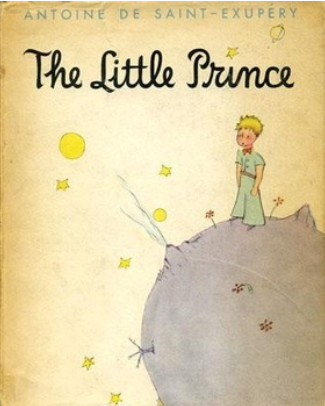
The Little Prince first editionbook cover — hand drawn by Saint Exupéry
As both protagonists slowly succumb to thirst, they move from one subject to another, each exchange unfolding as a poetic metaphor open to the reader’s interpretation. The book is imbued with a childlike sense of wonder that the author longed to rediscover in a world fractured by war and totalitarianism. It was first published in English and French in the United States in April 1943, and was only posthumously published in France following its liberation from the Vichy Regime.
Despite its somber undertones, the book is full of fantasy straight out of the mind of a child. At the very beginning of the story, the narrator is reminded through the Little Prince’s expectations that not everything needs to be realistic and serious to make sense, in spite of what grown-ups teach us when we are kids. This innocent outlook is eventually what allows him to remain hopeful in this life-or-death, helpless situation. The book’s touching message and its universal themes of love and compassion are ultimately what have allowed it such widespread appeal.
Today, the book that was once prohibited from publication in its own home country is now one of the best-selling works of all time, with an estimated 200 million copies sold worldwide. Beyond that, The Little Prince is the most translated work of fiction in history after the Bible, having been translated into over 600 languages and dialects. It can truly be considered a universal story, if such a thing exists, appealing to both children and adults across every corner of the globe.
Wherever you are on the globe, you will be moved by this ode to life, a memorial “not just to the Prince, but also to the time the Prince and the narrator spent together” (Antoine de Saint-Exupéry).