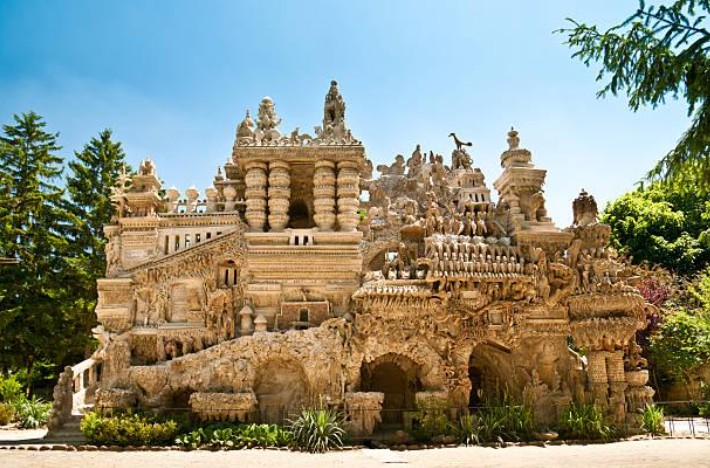
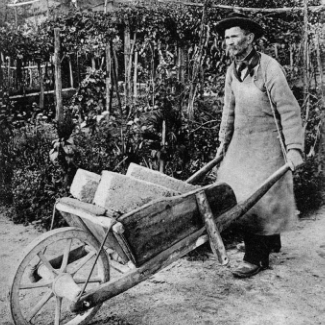
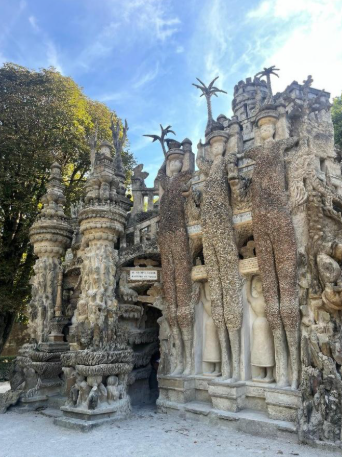
Born in 1836 into a family of farmers in the small village of Charmes-sur-l’Herbasse, Joseph Ferdinand Cheval was just an ordinary man, a postman who later became an artist. At the age of 31, in 1867, Mr. Cheval started his career as a postman in the region. Twelve years later, on a spring day during his daily route, he knocked over a small rock, the first rock he would then use to start building the palace. That is when the journey of a man who would hand-build a life-size palace began, a project that would take him 33 years of hard work.
Every day, along his 30-kilometer walk to distribute mail, Ferdinand collected rocks and transported them in his wheelbarrow. Later, he assembled them to create an impressive architectural structure, now nationally famous. He drew inspiration from postcards from all over the world that he saw thanks as a postman. Indeed, we can recognize, on the building, references and styles from different parts of the globe, a true tribute to the cultures of the world.
Ferdinand did not build only a “palace”, but a true work of art that allows each visitor to travel through imagination. When entering the site, there is something to look at on every façade, every little corner of the building, from floor to ceiling. Mr. Cheval sculpted animals such as sheep, dogs, snakes, but also Hindu temples, an Algerian house, and even a castle from the Middle Ages. The structure is a real pleasure to the eyes, and you never get tired of looking at it, as you see something new every time you go.
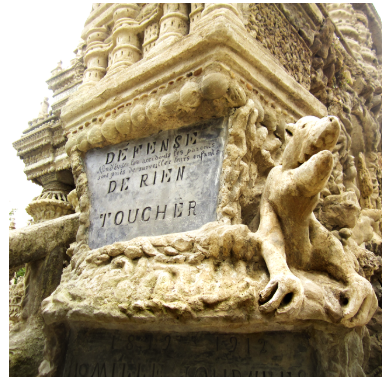
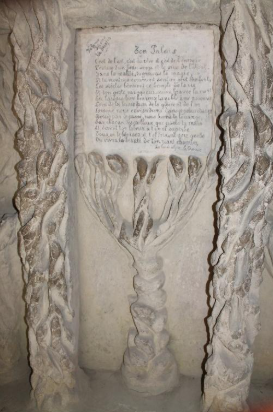
You can also wander through this impressive building, trying to imagine the story behind the rocks and shells in the different rooms and caves. Additionally, from the first floor, you can admire what was once the garden of Ferdinand Cheval. However, this structure goes well beyond its architecture; it is a unique mix of arts with engraved poems and quotes, such as “Ton idéal, ton Palais” by Emile Roux Parassac.
Le Palais Idéal du Facteur Cheval has gained a lot of recognition over the years. Firstly, Mr. Cheval was considered, from 1920 onward, the precursor of surrealist and naïve art and became an inspiration for many artists such as André Breton and Max Ernst. Later on, in 1969, the “palace” was classified as the only example of naïve architecture by André Malraux (French minister of culture at the time). Naïve art is very well developed but much less so in architecture which makes the work of Ferdinand even more special. Finally, in the same year, A. Malraux also classified the building as a historic monument.
Very popular in France but also worldwide, the Palais Idéal du Facteur Cheval is the impressive result of the work of one man, over 33 years. Open to the public, it is not only a source of inspiration for other artists but also for visitors who can learn not only about French culture, but also about cultures from around the world.