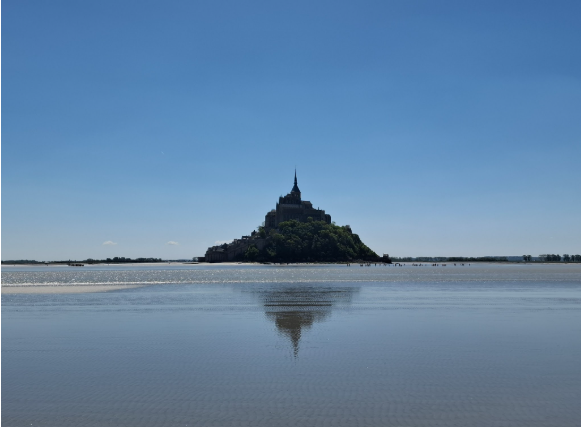
There is a place in northern France where water meets the earth to create a landscape most could only describe as ethereal. This is Mont-Saint-Michel: a small rocky island in Normandy, rising dramatically from the heart of an immense bay. When the tides are high, it becomes completely surrounded by water, creating a spectacle only dreams could dare recreate.
This place was once known for the danger posed by the land around it. It stands isolated in the middle of a vast plain of sand, upon which the sea advances with the speed of a galloping horse when the tides are high, completely cutting off the mountain from the mainland and transforming it into an island. When the tides recede, however, the sand plateau re-emerges, making the island accessible once more by foot. But those who dared to venture across this treacherous terrain faced a deadly foe: the entire area is surrounded by perilous quicksand, so treacherous that walking there alone is strictly forbidden. Should someone become trapped without knowing how to escape, they would remain ensnared until the returning tide swallowed them whole.
For this very reason, during the Middle Ages, locals believed that the devil had laid claim to this place, and that the quicksand was his way of dragging wayward travelers down to the depths of hell by the feet. The area thus gained a sinister reputation… until everything changed.
On the night of October 16, 708, Saint Aubert, bishop of Avranches claims to have been visited by the Archangel Michael in a dream. The angel had told him to build a church on an island caught between the devil and the deep blue sea, then known as Mont Tombe (Mount Grave). The bishop dismissed these demands at first, doubting they were real visions, so the Archangel came to him again and poked him in his head as proof of his honesty. Today, the hole supposedly left by the Archangel’s fiery finger can still be observed on the skull of Saint Aubert.
During the Hundred Years’ War, the island became a crucial strategic asset. Despite the British occupation of much of northwestern France, Mont-Saint-Michel remained unconquered, fiercely defending its French identity for decades. English forces, including those led by Thomas Scales, launched two major assaults but were repelled each time. The 119 French knights stationed there defended the island with their lives, cementing its status as a symbol of French resistance. As the English retreated, they abandoned two bombards, which the locals preserved as trophies of victory. These cannons can still be seen on the island today.
The abbey experienced high levels of change through the ages not only to face military threats, but also to respond to the artistic tendencies of the time. What results is a fusion of Romanesque strength and Gothic elegance plastered with layers of protective walls. The layout of the building represented a medieval mindset in its very design: common folk gathered in the lower church, nobles occupied the middle levels, while monks prayed in the upper abbey… all of them looking up to the world-renowned spire, like the finger of man emerging from the wasteland that surrounds it, pointing towards unseen heavens.
Picture of Mont-Saint-Michel from the bay, taken on April 29th, 2025
Much more could, and probably should, be said about the history of this place. One could ramble for hours about how it long stood as a point of contention, divided between Normandy and Brittany. Or how the Mont served as a prison for over a century, until influential figures such as Victor Hugo or Napoleon III himself helped restore its status as a historical monument. Too many stories to tell for a place so beautiful it would be a waste not to praise rather than describe.
In 1979, Mont Saint-Michel was one of the first sites to be bestowed the title of UNESCO World Heritage Site due to its human-created beauty as well as historical importance. Some 2.5 million people come to the north coast of France to see the castle each year, making it one of the most visited places on Earth, and the second destination of choice in France.
Whether for religious reasons in the past or for tourism today, the site still seems far from ceasing to inspire dreams the same way it has been doing for over a millenium.