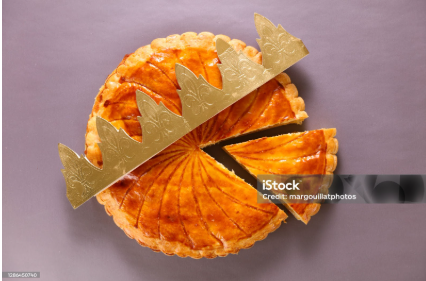
January arrived abruptly. Christmas is over, a new year has just begun, and your boring everyday routine has come back. But between the grey skies and the sound of mourning, a delightful smell arises. Coming straight out of every bakery, a glimmer of hope in the form of a sun-shaped cake carries you through the pain.
Epiphany is a Christian holiday many countries celebrate all across the world. It marks the last of the 12 days of Christmas, celebrating the moment when the Three Wise Men, called Rois mages in France, supposedly visited the newborn baby Jesus, recognizing him as the Son of God. With them, they brought riches from every quarter of the globe, including gold, myrrh, frankincense… and apparently, lots of food!
This late gift is the one which has, over the years, shaped the French idea of the event the most. While Los Reyes Magos play a role in the celebration of countries like Spain, where actors dress up to march the streets and give Spanish children gifts of all kinds, épiphanie is a much more restricted tradition in France. All we do to celebrate is gather with friends and… eat. But what a meal it is.
In France, it is customary to eat a pie most have only fond memories of: La galette des Rois. It’s a rich dessert made of a layered dough filled with frangipane (an almond buttery paste). Those that cannot eat almonds eat apple or chocolate-flavored galettes, meanwhile the south prefers to feast upon fruit cakes or brioche des rois instead.
Eating a galette is a whole ceremony, a tradition which persists even to this day. First, the youngest at the table goes underneath the table where the galette is set, so as not to see what is happening atop. The galette is then cut into slices and distributed to each person present. In order to decide who gets which piece, the distributor asks the kid under the table who to give each slice to, to which the youngling answers by electing someone to receive it. The catch is that, in one of the slices, there is a fève hidden, a small porcelain figurine often representing a biblical character. The one who gets the fève is then crowned king for the rest of the day. That way, everyone gets to participate in the party.
This tradition supposedly dates back to ancient times, when Romans would exceptionally share a cake with their own slaves to celebrate the Saturnalia, a pagan festival during the winter solstice. In this cake was said to be placed a bean, and whoever received it was crowned king and was entitled to receive whatever they asked for one day. The Romans later converted to Catholicism, and the tradition was spread to other Christian countries as well.
Today, more than 1,500 years later, though the very existence of the three magi is contested, and though the tradition has lost most of its religious connotations in countries like France, it is still widely popular. According to a 2018 IFOP study, 94% of French people declare eating galette des rois at least once in January, and more than half have admitted to eating it more often than that, even when it is not Epiphany anymore. All of these factors culminate in over 30 million galettes being sold each January alone, truly making this dessert one of France’s favorites. And why shouldn’t it be? Everyone likes to share a hearty meal with friends and family, especially when fond memories of laughter and carelessness resurface with it.
So what are you waiting for? At the time of publication of this article, Epiphany will already be over, but bakeries will continue to make galettes des rois until somewhere around the end of January. So go support your local bakery and call your friends and family to enjoy a nice galette with them.