The time is one for festivities. Winter colors fade under a darkened sky, the gentle wind whistles a familiar tune. The bright lights of December finally fill the air that smells of hot cocoa and cream. Sing along, you know the words. After all…
it is “the most wonderful time of the year”
While Christmas isn’t celebrated everywhere or by everyone, it is unexaggeratedly one of the most widespread – and beloved, for that matter – events on the planet. According to the World Population Review, Christmas is a “Formal Public Holiday” in 160 countries and is celebrated even in countries where it does not possess that status, giving it a reach far beyond that of Christian-majority countries.
After all, many other cultures also consider early winter as a time for celebrations; Hanukkah among Jewish communities, Yule for German pagans, or Saturnalia in ancient Rome, are (or in some cases, were) influential festivals which all contributed to the sheer scope of Christmas around the globe. And yes, as you may already have noticed, that also includes France!
How does France celebrate Christmas?
Historically, it seems like Christmas used to be much smaller in France than it is now. Unsurprisingly, it had a much greater importance in Christian families, but not exactly in the way we know it today. Most French people who were alive before the 1980s would probably tell you that the act of gift-sharing wasn’t exactly a Christmas tradition; rather, it happened on the 6th of December for Saint Nicholas day!
In modern days, the version of Christmas that we celebrate is very close to the one celebrated worldwide. The country is laïque, but in true ceremonial deism fashion, celebration itself appears to have lost much of its religious connotation in the eyes of many. Families will decorate a Christmas tree called sapin de Noël, around which they gather in awe. Kids will choose an advent calendar, opening a small window each day of December to find a little gift – often chocolate – while waiting for the 24th to come.
Christmas carols are a cultural phenomenon here: the most famous of all, “Petit papa Noël”, has been not only the best-known Christmas song in France but also, since 1946, the best-selling single of all time in the country. Meanwhile, “Entre le bœuf et l’âne gris” is renowned as one of the oldest Christmas songs, and the first in France.
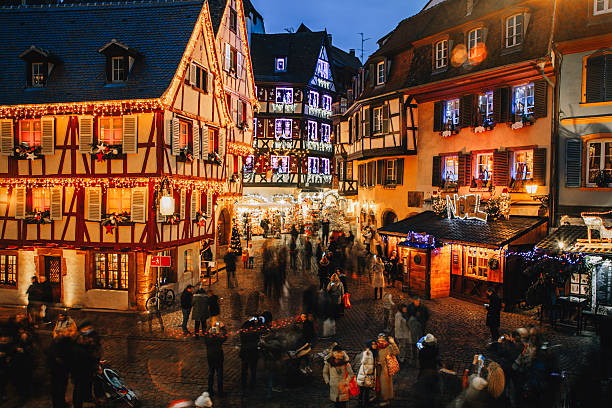
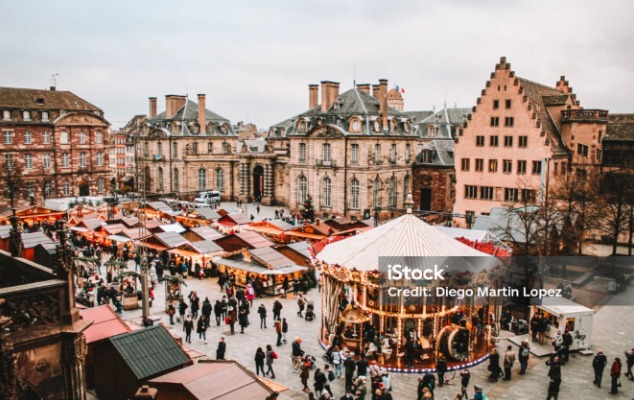
Finally, one of the major aspects of a French Christmas is its wonderful Christmas markets. Strasbourg’s is a national heritage, one of the most visited in the world and the reason behind the city’s title of “city of Christmas”. Meanwhile, many other towns and cities set up their own temporary markets (the closest example for you would be located at Place Carnot, right next to UCLy), where you can buy many Santons, small hand-painted figurines used for building nativity scenes, and find many other gift shops. But more prominently, you will find food in large quantities, making the air in Christmas markets often smell quite delightful.
Speaking of which…
What does a French Christmas meal look like?
If there is one thing everyone gets out of this time period, it is most undoubtedly the food. Tartiflettes (a rich potato, cream, and cheese-based casserole) and raclette cheese await you at every stand, and hot wine sellers at every street corner. As per the tradition in the north, Saint-Nicholas-shaped gingerbread is eaten around the 6th of December, and everyone tries their shot at making their own sablés to share with you and your friends… Tough time to be on a diet.
On the long-awaited Christmas Eve, families and friends try their hardest at making a meal to remember. What results is a feast, the size of which finds equal only in the richness of its taste. It unfolds in many steps:
First and foremost, and indispensably so, comes the apéritif. This is the part where potato chips, saucisson (very popular dried French sausages), and toasts will be eaten, and where champagne will be drunk. This is also where most people have foie gras, an expensive delicacy made by fattening the liver of a duck by force-feeding until it reaches sizes up to ten times its initial volume… Meaning that the only way for you to enjoy it would have probably been to remain in ignorance.
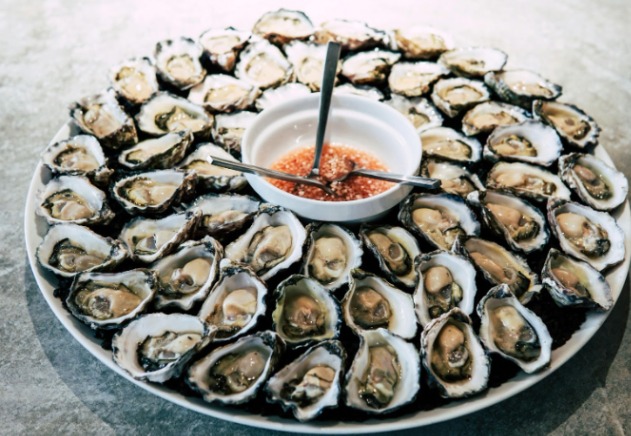
Then comes the main course, if your stomach isn’t already full. There is no “Standard French Christmas meal”, but rather, an array of options to choose from. Roasted capon, smoked salmon, garlic soup, even snails are all common choices. The most renowned ‘Christmas food’ here in France is probably oysters, a dish half of the population seems to love, and the other half hates with a burning passion.
Finally, for the mightiest eaters, comes dessert. After everyone is done with the customary cheese plate, the bûche de Noël (Christmas log) is brought to the table. This log-shaped cake was inspired by the tradition to burn a log in the chimney during the Christmas period as a sign of good omen. As nobody is ever hungry enough to finish it, the tradition continues nowadays, as the cake itself seems to last for days on end.
Regardless of whether you celebrate Christmas for religious reasons or not, whether you spend it with family or alone watching Le père Noël est une ordure (Santa Claus is a Stinker), or whether you like oysters or not…The end of the year truly asks for comfort. Everyone deserves to enjoy the wonders this event generates in the eyes of children around the world.